Choose your region and language

Go

Menu

First sod turned on critical HVDC transmission project – a link to Australia’s battery of the nation

Blog Post | 02.10.2026 | 6 min read | Bernard Norton

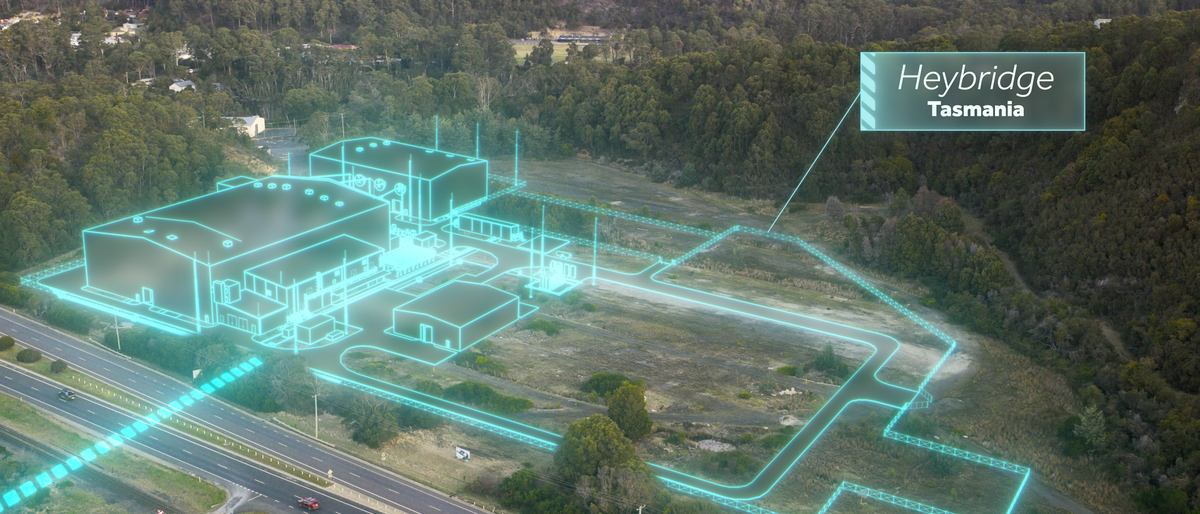
This week marked a major milestone in Australia’s nation critical Marinus Link project with the official commencement of work on the site of the converter station on Tasmania’s north-west coast.

Initial planning for Marinus Link began in 2017 with this week marking the start of the construction journey for the converter stations that are the brains and beating heart of the project which will help unlock Tasmania’s deep storage potential and deliver more renewable energy for the National Electricity Market.

The sod turning construction commencement ceremony on the site of the future converter station in Heybridge, Tasmania’s north west was a significant moment to join a number of distinguished guests and project partners along with the Hon. Chris Bowen, Minister for Climate Change and Energy, the Hon. Jeremy Rockliff, Premier of Tasmania, and Tom McIntosh MP, representing the Victorian Government.

Hosted by Marinus Link together with Tas Networks, Hitachi Energy joined project partners including Prysmian, TasVicGreenLink and Samsung to officially mark the start of work.

Project Marinus is yet another example of the transformation that is occurring in Australia’s energy system, and the pivotal role electricity transmission is playing in the energy transition.

There have been a number of similar moments lately.

The completion of Project Energy-Connect - the South Australia and NSW interconnector, the commencement of works for the Central West Orana Renewable Energy Zone, the substation fit outs being finalised for the HumeLink project; and the recent notice to proceed on Tasmania’s North West Transmission Development.

They are all part of the 6,000 kilometre expansion of the country’s transmission infrastructure; and a beacon to renewable energy investors and new industries seeking sustainable energy.

Marinus Link’s role in the National Electricity market

The Marinus Link Project will connect the electricity grids in Victoria and Tasmania via a 345 kilometre transmission cable.

The 320 kV line will run underground through 90 km of Victorian countryside and under the Bass Strait seabed for the remaining 255 km.

Hitachi Energy will provide our advanced Grid Forming High Voltage Direct Current (HVDC) converter technology inside the converter station at each end of the transmission cable so electricity can safely and efficiently flow between the state’s two electricity networks.

HVDC is used worldwide, particularly in undersea applications, as it is the most efficient way to transmit bulk power over long distances – meaning more energy can find its way to where it’s needed.

The scale of the equipment being used in the fit out is impressive.

Forty-eight 11 metre high valve stations, eight giant HVDC transformers, plus a range of high voltage power quality equipment.

Marinus Link will help Tasmania import excess solar and wind energy from the mainland and export hydro and wind power back when the mainland needs it most.

Tasmania is blessed with some of the best hydropower resources in Australia. Along with the Snowy scheme this resource builds resilience into the interconnected electricity system by providing deep long-term firming capacity supporting renewable energy from intermittent resources such as wind and solar. Hydro is an important element in the mix for building our sustainable energy future with the lowest cost technology mixed with shorter duration battery systems.

It is estimated that Marinus Link will be a major catalyst for new renewable energy in both Victoria and Tasmania. A major driver for up to 3 GW of wind in Tasmania and 15 GW of solar and onshore wind in Victoria and will help unlock the, so called, Battery of the Nation project in Tasmania.

Hitachi Energy’s HVDC technology which will be deployed for the Marinus Link project has a dual role in the Victorian and Tasmanian electricity systems. Not only will it help transport electricity more efficiently, but it will also play an important role of supporting the grid with the implementation of grid forming technology – an Australian first.

Grid forming technology such as that being deployed for Marinus Link provides system services which were traditionally provided by the large synchronous generators which are progressively being retired from the system. Given two-thirds of our country’s coal fired power stations are scheduled for closure by mid next decade, grid forming technology plays an increasingly important role in the electricity system.

Marinus Link is unique. It builds resilience in the energy system through interconnection and greater access to deep firming capacity, but also by supporting system strength services.

Marinus Link - a national strategic asset

Australia’s long and stringy electricity transmission network has long been characterised as relatively weak due to its lack of diverse inter-connectors across state boundaries. On occasion, this stops the cheapest energy from being able to flow to where it’s needed.

Project Marinus – and several others like it – are helping to break this cycle. It is expected to push down wholesale energy prices and deliver power bill savings to energy consumers across the NEM, with the largest savings felt in Tasmania and Victoria. By unlocking Tasmania’s energy reserves and new renewable energy, it will deliver more competition in energy markets and displace higher-priced generation.

By lifting the level of lower cost renewable energy, it can also create opportunities to lift sagging productivity by helping to drive down business costs and encouraging new business investment.

In this regard, on both the consumer and business side, projects like Marinus Link will become national strategic assets – building a strong grid and stronger economy. It will also make a major contribution the development of skills and knowledge across the country.

In its recent Targeted Workforce Update, the Powering Skills organisation estimated that there would be a shortfall of more than 40,000 energy trade workers by 2030.

It’s particularly pleasing that our Australian workforce including Hitachi Energy’s R&D and manufacturing site in Lilydale, Victoria will play a key role in the engineering and production of key power quality equipment for the Marinus Link project. Our local workforce will be blended with our global expertise and will be supported with apprenticeships, traineeships, and other skills development initiatives.

One of Australia’s leading economist recently concluded that the Marinus Link project was in the ‘national interest’.

I would add that not only will it become a national strategic asset, but also a world class and national engineering asset that will deliver benefits for consumers and to the grid for decades to come.


Bernard Norton
Managing Director, Hitachi Energy Australia

Bernard Norton, Managing Director of Hitachi Energy Australia, leads the company’s growth and industry collaboration to accelerate the nation’s energy transition across key sectors including utilities, mining, renewables, data centres and transport. He champions an inclusive, purpose-driven culture and strong industry partnerships to drive sustainable innovation and impact.