Selecciona tu región e idioma

Menú

One Platform. Total Offshore Visibility.
How OceaniQ™ Monitoring by MicroSCADAX is redefining offshore wind operations

Blog Post | 22.04.2026 | 4 min read | Claus Vetter

Offshore wind is entering a new phase of scale and complexity. Global installed offshore wind capacity is expected to more than double by the early 2030s, driven by larger turbines, deeper waters, hybrid AC/DC grids, and increasingly digitalized operations. As projects grow in size and distance from shore, operators face a clear challenge: maintaining high availability while managing more systems, more data, and tighter operational margins.

For more than a decade, Hitachi Energy has helped shape offshore wind automation—supporting over 35 projects and approximately 35 GW of installed offshore wind capacity worldwide. Across Asia, Europe, and North America, our SCADA solutions enable offshore grid connections and wind farm interfaces for leading developers, independent power producers (IPPs), and EPCs.

Now, we are taking offshore wind monitoring to the next level.

Built with offshore wind operators, for offshore wind operations

As offshore wind assets mature, operational complexity is becoming a defining cost and risk driv-er. Industry studies show that operations and maintenance can account for 25–30 percent of the lifetime cost of an offshore wind farm, with unplanned interventions among the most expensive contributors.

Through years of engineering, delivery, and operation of MicroSCADA solutions—integrating off-shore substations and wind farms with all typical offshore wind turbine generator (WTG) prod-ucts—we worked closely with operators to understand these challenges firsthand.

A consistent message emerged: offshore assets rely on many subsystems, each with its own in-terface. Switching between systems slows response times, increases operational risk, and com-plicates long term asset management.

Together with leading IPPs, including RWE, we translated more than 50 operator-driven re-quirements into the next evolution of offshore wind SCADA.

“By working closely with leading offshore wind IPPs, we’ve co created the next generation of MicroSCADA for offshore wind. OceaniQ™ Monitoring by MicroSCADA X reflects real opera-tional needs—bringing together years of field experience, customer insight, and engineering ex-pertise to simplify monitoring and strengthen operational confidence across offshore assets,” Claus Vetter, SVP – Head of Automation & Communication, Hitachi Energy

 

Introducing OceaniQ™ Monitoring by MicroSCADA X

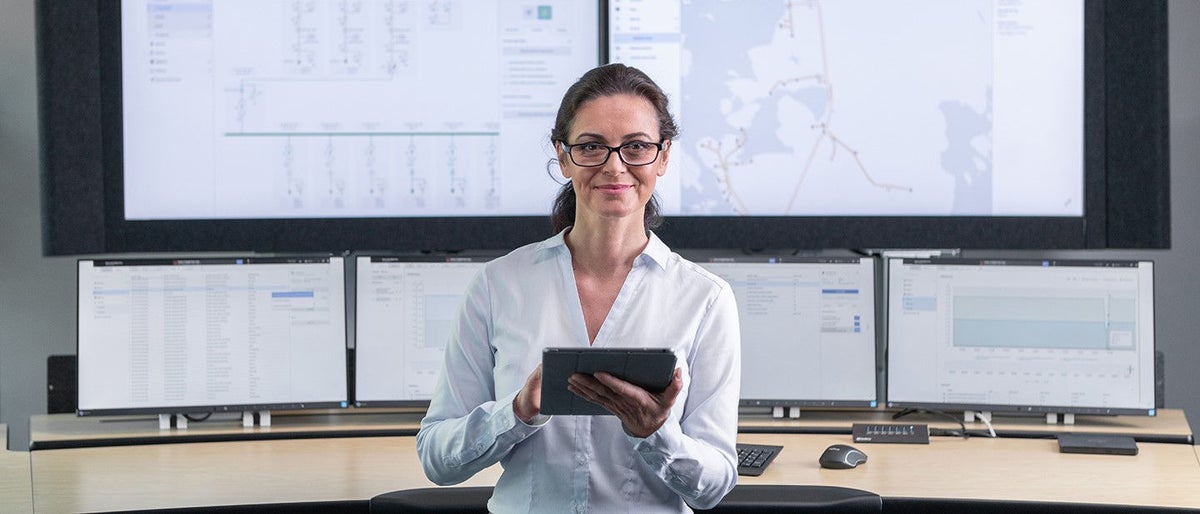
Developed over three years, OceaniQ™ Monitoring by MicroSCADA X unifies offshore wind monitoring into a single, intelligent platform—covering both the offshore substation and the wind farm.As offshore projects increasingly combine HVAC, HVDC, and hybrid electrical architectures, Mi-croSCADA X provides structured situational awareness across electrical and non electrical sys-tems—from commissioning through decades of operation.

MicroSCADA X continues to supervise the complete electrical scope of offshore substations and integrates with all major WTG platforms using industry standard protocols, including IEC 61850, IEC 60870 5 104, OPC UA, and DNP3.
 

One system. The entire offshore platform.

To support the industry’s shift toward integrated, datadriven operations, OceaniQ™ Monitoring by MicroSCADA X expands beyond electrical supervision to include auxiliary and utility systems across the offshore platform.

Using RTUs or direct standard protocol integration, the system continuously monitors safety, en-vironmental, and operational subsystems—and alerts operators immediately when thresholds are exceeded or equipment performance deviates.

The result is a single, consolidated view of the entire offshore asset—supporting faster decisions, clearer accountability, and safer operations.
 

We began our cooperation in 2025, and since then, Hitachi Energy has supported RWE on numerous offshore wind projects across Europe. We value partners who involve us early and give us a direct voice in product development, ensuring solutions like MicroSCADA X are designed to support reliable, efficient operation as our offshore wind portfolio continues to grow.


Christoph Straub, Team Leader Digital, Instrumentation, SCADA & Control, RWE

Faster response. Smarter maintenance.

As offshore wind farms move farther from shore, response time and preparedness become criti-cal. MicroSCADA X is designed to support condition-based maintenance and faster fault resolu-tion by delivering:

  • Prioritized, easy-to-understand alerts
  • Clear visual mapping from platform → deck → room → device
  • Actionable insights for operators and maintenance teams

Maintenance crews arrive with the right expertise and spare parts. Offshore visits are shorter, safer, and more targeted, supporting higher asset availability and lower operational risk.

Broad subsystem coverage

MicroSCADA X supports unified monitoring across offshore wind assets, including:

  • Wind turbine systems
  • HV/LV switchgear, ACDB and DCDB
  • HVAC and HVDC systems
  • Power transformers and cooling systems
  • UPS and battery systems
  • Diesel generators and fuel systems
  • HVAC and fire protection systems
  • Weather stations and navigation aids
  • CCTV, communications, and alarm systems
  • Cranes, drainage, and auxiliary systems

Additional subsystems can be integrated per project or standardized through framework agreements.

Why OceaniQ™ Monitoring by MicroSCADA X?

MicroSCADA X for Wind delivers a centralized, secure, and user-friendly monitoring environment purpose built for offshore win, aligned with the industry’s move toward digitalized, long-life assets and data‑driven operations.

With optional secure mobile access, field crews gain real‑time visibility directly at the asset. Modern, intuitive interfaces support clarity under operational pressure—onshore and offshore.

Discover how OceaniQ™ Monitoring by MicroSCADA X can simplify offshore operations and improve asset visibility across the full lifecycle.

Sources:
 

  1. Global Wind Energy Council (GWEC), Global Offshore Wind Report (latest edition)
  2. International Energy Agency (IEA), Offshore Wind Outlook
  3. DNV, Offshore Wind Cost Reduction and O&M Insights
  4. WindEurope, Offshore Wind in Europe – Market and Technology Trends
  5. IEC, IEC 61850 and Power Utility Automation Standards Overview

Claus Vetter
Head of Global Product Group, Automation and Communication at Hitachi Energy.

Claus Vetter, Group Senior Vice President, Head of Automation and Communication at Hitachi Energy, has over 30 years of experience driving innovation in the energy sector. He holds a PhD in Electrical and Electronics Engineering from Hamburg University of Technology, a Master of Engineering from the Technical University of Munich, and a business management certificate from IMD Business School.