
Marinus Link: Hitachi Energy’s grid-forming HVDC technology drives Australian renewable energy superhighway
Features | 02.10.2026 | 6 min read
Features | 02.10.2026 | 6 min read
The key to Australia’s large-scale energy transition doesn’t just rest with the solar, wind, and battery storage systems that are increasingly powering the country, but a new network of transmission assets deemed critical to its future.
This massive rebuild of network infrastructure is already underway, creating new connections between states and linking new regions of renewable energy to large cities and industrial zones.
But it must continue – and at scale.
The challenge of this massive rebuild has been laid bare in the Australian Energy Market Operator’s planning blueprint called the Integrated System Plan.
More than 6,000 km of transmission lines must be built, it says, expanding the existing network by about 14 percent over the next 15 years. Electricity lines and substations are being built across the vast outback and over mountains, crossing rivers and plains, and circling cities and regional centres.
But one project stands out for its scale, technology, and engineering feats – and for its critical role in unlocking an entire state overflowing with deep storage and renewable energy potential.

Marinus Link was conceived more than a decade ago as a subsea electricity cable linking the southeastern Australian state of Victoria with the island state of Tasmania. Tasmania’s network of inland rivers and mountain lakes delivers abundant hydropower while its coastal regions, particularly in the north of the state, are rich in wind resources.
The state has been at net-zero emissions for the past 11 years, meaning it removes more carbon than it puts out. However, the ambitions go further with a legislated 200 percent renewable energy target by 2040.
The Marinus Link project is crucial to achieving this target. It will export its excess hydropower and wind energy to Victoria when it is needed there. And Victoria will return the favour, sending solar power to be stored in its network of pumped-hydro systems. It’s the support act for a giant battery for the national grid, helping to access Tasmania’s deep-storage hydropower for the Australian mainland.
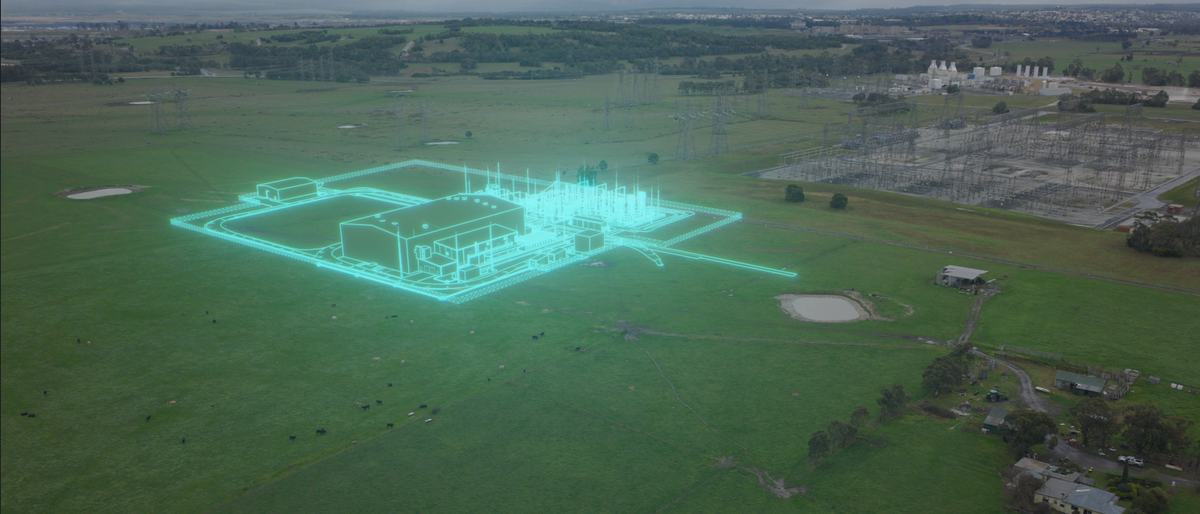
In its first stage, to be commissioned by 2030, Marinus Link will provide 750 megawatts (MW) of capacity, enough energy to power 750,000 homes. To achieve this, a 255-km 320-kilovolt (kV) electricity cable will be buried about 1.5 metres below the Bass Strait seabed. It will then resurface at the tip of Victoria’s Gippsland region, where it will travel another 90 km underground to a high-tech converter station.
What makes this project so special is the state-of-the-art high-voltage direct current (HVDC) technology supplied and installed by Hitachi Energy – dubbed the “beating heart” of the project.

Getting energy to flow both ways across the Bass Strait requires an advanced transmission system capable of operating over long distances and uniquely challenging environments.
Hitachi Energy’s HVDC technology is the globally preferred solution for this type of electrical engineering challenge. It was originally conceived in Sweden more than 70 years ago and is now used worldwide to power global cities like New York and Mumbai and connect regions like Europe and the United Kingdom.
For Marinus Link, two large converter stations will be built, one at each end of the Bass Strait.
These stations will convert alternating current (AC) from the electricity grid into direct current (DC) for transmission – and back again at the receiving end. It can transport energy with much lower losses and with greater controllability. Crucially, it is the HVDC technology that enables Tasmania’s stable hydropower to complement the variable wind and solar generation on the Australian mainland, allowing energy to flow in either direction according to where it is needed.
Hitachi Energy will engineer and deliver the entire HVDC system for the project, drawing on its global technology leadership, manufacturing footprint, and partnerships. This will include vital equipment and components made in Australia to ensure stable, efficient operation, and real-time control of power flows – the key to supporting the integration of renewable energy.
Four HVDC converter transformers , weighing between 240 and 260 tonnes for the transport, will be installed at each converter station, this weight increases to around 330 tonnes once installed. Along with two dozens 11-metre-high valve structures, each equivalent to a three-metre-high building.
What sets this project apart from other similar transmission technologies in Australia is that its converters do more than enable efficient power transmission. They can also help provide the electrical stability the grid needs as coal-fired generation is phased out.
For decades, Australia’s coal-fired power stations did more than produce electricity. Their large spinning machines also helped steady the grid. As those plants retire and more renewables come online, that stabilizing function needs to come from somewhere else.
That is where power electronics technologies come in. Hitachi Energy’s HVDC technology for Marinus Link can support the voltage and frequency, mimicking the behaviour of the generators in the decommissioned power stations. This behaviour is called grid-forming and ensures resilient grid operation.
This grid-forming superpower is becoming increasingly more important in Australia as its old coal-fired power stations close and cleaner, but intermittent, renewables are added.
In its latest ISP, AEMO projects that two-thirds of Australia’s remaining coal-fired power stations will retire by 2035, with the remainder shutting down completely by 2050. And with each closure, new grid-stability services are required to help maintain reliability.
Australia’s electricity system is at a critical stage of the energy transition. Retiring baseload generation must be replaced with new renewable generation, storage, and firming capacity while rising demand from electrification and digital industries, including hyperscale data centres, places additional pressure on the grid.
Meeting these challenges requires significant investment in transmission infrastructure to connect renewable energy resources to major load centres to support Australia's energy transition and economic growth.
HVDC interconnectors such as Marinus Link are a key solution.
The nation-critical Marinus Link project has been likened to a renewable energy superhighway. It has been recognised as a cornerstone project of the Australian Government’s Rewiring the Nation Plan and classified as urgent in the Australian Energy Market Operator’s national energy plan.
As a two-way interconnector, Marinus Link will allow electricity to flow in either direction, improving flexibility, reliability and resilience across the National Electricity Market, getting the most out of hydropower, wind and solar resources, and bringing on new investment in industry and generation..
Over the past year since Financial Close, Marinus Link has continued to hit milestone after major milestone, achieving critical approvals, mobilising our contractors, and importantly already delivering real benefit to communities in North West Tasmania and across Gippsland.
The project will also bring significant employment, supply chain, and economic opportunities for regional communities, particularly in Gippsland, Victoria, and North West Tasmania.
According to updated modeling by Ernst and Young (EY), construction and operations of Project Marinus are expected to provide more than $2 billion to the Tasmanian economy, and $1,78 billion to the Victorian economy.
These sorts of transmission projects provide essential interconnection across Australia’s electricity grid, making the entire system more secure and reliable, and helping keep downward pressure on wholesale electricity prices.