
Darwin‑Katherine BESS strengthens the Northern Territory grid with fast, flexible essential system services
Customer Story | 4 min read
Customer Story | 4 min read
The Northern Territory’s first grid‑forming battery delivers fast, flexible essential system services, reduces gas dependence, and supports a more reliable, lower‑emissions power system for over 180,000 residents[1].
With more than 80% of its electricity coming from gas, the Northern Territory's power system looks very different from those in Australia's interconnected markets. In the Darwin–Katherine region, the grid operates as a small, isolated system outside the National Electricity Market, which means Territory Generation must deliver reliability and system strength locally and in real time, with no interconnection to fall back on.
For decades, gas turbines formed the backbone of the Northern Territory's power system, supplying electricity while simultaneously delivering the support services the network depended on. As the region's largest wholesale electricity producer, Territory Generation built its entire generation fleet around that services model.
But that model is now under pressure. The rapid uptake of solar across the network has made the system more complex to operate, and gas turbines are now required to stay online, not to generate electricity, but purely to maintain system strength and provide grid stability.
| Main data | |
|---|---|
| Project | Darwin‑Katherine Battery Energy Storage System (DK BESS) |
| Power | 32.6 MW |
| Customer | Territory Generation |
| Capacity | Channel Island Power Station, Northern Territory, Australia |
| Location | DC links in AC grids; Interconnecting grids |
| Challenge | Reducing gas reliance while maintaining system stability |
| Solution | Grid‑forming BESS with advanced control systems |
| Impact | O&M savings, emissions reduction, improved grid stability, more solar integration, and lower fuel use |
This has created a mounting challenge for both Territory Generation and the system operator: each gas turbine which keeps running solely for stability services consumes fuel gas, accumulates maintenance costs, and produces emissions, without delivering additional energy. As solar generation in the power system continues to grow, that trade-off has become increasingly difficult to justify.
Territory Generation selected Hitachi Energy to deliver a battery energy storage system capable of replicating the gas turbine functions (system strength, inertia, frequency control, and voltage regulation) through advanced power electronics rather than combustion and rotating machines.
The selection drew on Hitachi Energy's 35-year presence in the Northern Territory and proven experience integrating large-scale battery systems into complex, isolated grids. That depth of local knowledge, combined with the engineering capability to deliver grid-forming technology at utility-scale, gave Territory Generation confidence that the solution would meet the stringent grid code requirements.
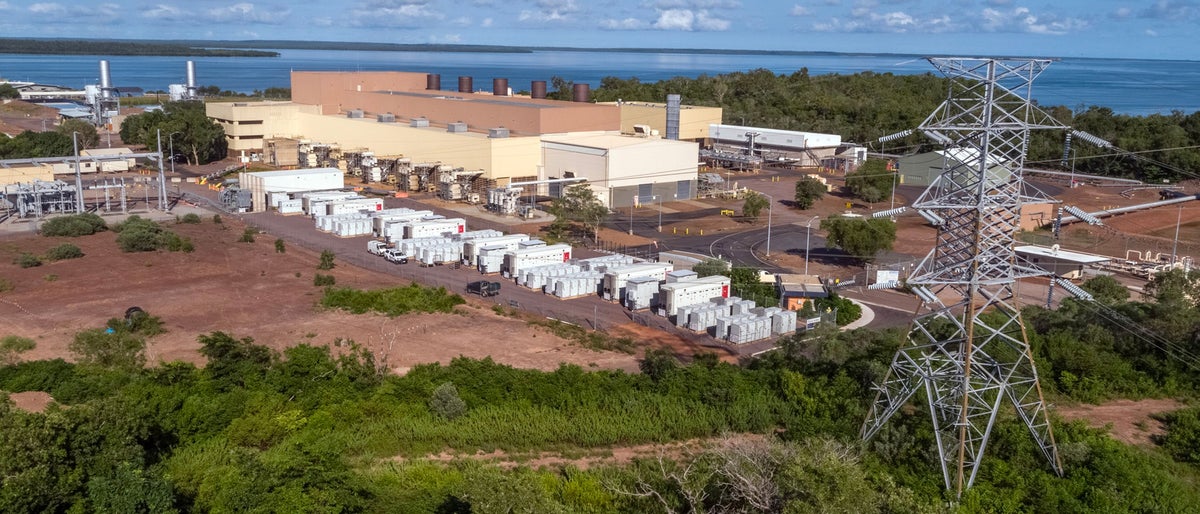
Commissioned at Channel Island Power Station and integrated into the 132 kV transmission network, the Darwin–Katherine BESS (DK BESS) comprises 192 battery units operating under the advanced Hitachi Energy power plant control systems.
The DK BESS now delivers essential system services independently, enabling gas turbines to be turned off and only dispatched for energy generation rather than kept running for grid support service alone.
Hitachi Energy scope:
The DK BESS is now delivering measurable results. Territory Generation is on track to achieve forecast savings, driven by the reduced need to run gas turbines for system support. At the same time, the project has so far saved more than 35,000 tons of CO₂, a direct consequence of fewer thermal assets running purely for stability.
For the broader power system, the benefits compound. With these same services now delivered through the BESS, gas turbines can be dispatched solely on energy needs, improving fleet efficiency and reducing operational risk. The power system is also better positioned to accommodate evolving generation patterns, including higher levels of solar, while maintaining power system reliability.
For the 180,000 Territorians who depend on the Darwin–Katherine network, the outcome is a power supply that is more stable, responsive, and cost effective.
Key outcomes
For Territory Generation:
For the grid:
For Territorians:
For the Northern Territory Government:
The transition to battery-delivered essential system services is already delivering tangible benefits — reducing fuel costs, cutting emissions, and improving grid stability.