Escolha a sua região e idioma

Ir

Menu

Leading the charge: State Grid Corporation of China’s decarbonization journey

Features | Global | 10.07.2026 | 5 min read

World’s first SF₆-free 550 kV gas-insulated switchgear makes State Grid Corporation of China a global pioneer of decarbonization.

Two years ago, it was a product prototype on a stage in Paris. Today, it’s powering a megacity in central China. This is the journey of the world’s first SF6-free 550 kilovolt (kV) gas-insulated switchgear (GIS) and what it means for the future of eco-efficient energy infrastructure.

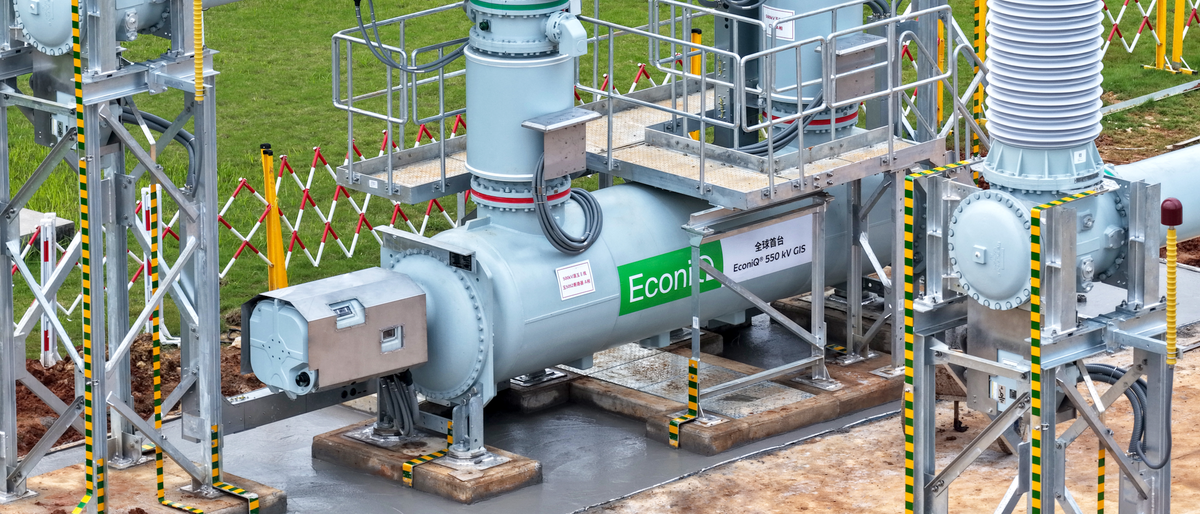
The substation in Yuxian, Wuhan, Central China’s Hubei Province, looks like any other large substation from the outside. However, inside the fence is something of historic significance for the industry: a fully operational GIS system free of sulfur hexafluoride (SF6) at 550 kV, the likes of which have never before been operated anywhere in the world. On May 29, 2026, it was connected to the grid, becoming the world's first operational 550 kV SF6-free GIS installation.

From a stage in Paris to a substation in China

The public journey began in the summer of 2024, at CIGRE Session in Paris, the power industry’s equivalent of a world stage. Hitachi Energy unveiled the EconiQ® 550 kV GIS to a global audience of engineers, grid operators, and policymakers. The excitement was tinged with a healthy dose of skepticism. Eliminating SF6 from high-voltage switchgear is challenging. Doing it at 550 kV, the domain of extra high-voltage transmission, adds difficulty.

In 2025, Hitachi Energy signed a Memorandum of Understanding with State Grid Corporation of China (SGCC) for the world’s first 550 kV SF6-free GIS. In September of the same year, it was recognized as world-leading in overall technology performance. Then came rigorous factory acceptance testing, on-site installation and commissioning. And finally, on a late-May morning this year in Wuhan, energization. The lights stayed on. The grid accepted it. The service started in real life.

Why SF6 has to go, and why 550 kV is the hard part

SF6 is the industry’s great paradox: a gas so electrically perfect that it became the universal insulator of high-voltage infrastructure, and so climatically harmful that it carries a global warming potential 24,300 times higher than CO2, persisting in the atmosphere for over a thousand years. Designing equipment without it at the lower voltages has been achievable for a few years. However, at 550 kV, the electrical demands are so tough that the industry assumed that SF6 was here to stay for many more years.

Hitachi Energy’s answer is a carefully chosen gas mixture (86.5 percent CO2, 10 percent O2, and 3.5 percent C4-FN) that provides the dielectric and arc-quenching performance the system demands, without the climate penalty. Over a 40-year service life, a conventional SF6 GIS bay generates insulation gases equivalent to approximately 1,674 tons of CO2. The EconiQ alternative generates just 12.6 tons, offering a 99.2 percent reduction, that directly supports State Grid’s lower-carbon ambitions and China’s Strategic Dual Carbon goals.

Partnering to advance sustainable grids

SGCC is the world’s largest utility, responsible for supplying power to over a billion people. When the Central China branch of SGCC placed the commercial order, it was taking a stand for the direction of China’s grid. The Wuhan Yuxian substation was chosen as a critical backbone node where reliability is non-negotiable. Together with Hitachi Energy, a possible role model would be set up for the sustainable upgrade of the existing 550 kV infrastructure across the country.

In early June, Dr. Yang Xiaoli, General Manager of Hitachi Energy High Voltage Switchgear (Xiamen) Co., Ltd., and State Grid representatives celebrated the successful commissioning of the substation. Later that month, on June 17, Dr. Bin Su, Senior Vice President of Hitachi Energy China and Head of the High Voltage Products Business Unit for North Asia, together with Dr. Christian Ohler, Head of Global Product Group High Voltage Switchgear, visited the State Grid Central China branch. Their conversations ranged across evolving market trends, technological innovation, and strategies to accelerate the decarbonization of high-voltage equipment.

The delegation was also invited to visit the Wuhan Yuxian substation, where they toured the region's first SF6-free "Green Heart" installation. It was a first-hand look at the practical implementation of next-generation sustainable technologies. The visit, and the partnership it represents, shows the strong collaboration between both organizations and the shared commitment to building a sustainable power grid.

What a global first in the extra-high voltage transmission grid actually means

It’s worth taking a moment to think about what “world first” means in this context. The EconiQ 550 kV GIS is not the world’s first prototype; it is the world's first commercial SF6-free GIS at 550 kV, connected to a live transmission grid and carrying electric load in a demanding and critical operational environment. It means the technology has crossed the most important threshold in the energy industry – it works at scale, in the real world. Every grid operator, every utility, and every policymaker considering extra-high voltage switchgear procurement now has a reference point.

Wuhan Yuxian is now an industry-historic place and a focal point for forces shaping the global energy system, including surging electricity demand, ambitious decarbonization commitments, and the urgent need to expand transmission infrastructure without embedding decades of greenhouse gas emissions. The high-voltage equipment installed in substations today will still be operating in 2065. The decisions being made now are more than operational choices. They are climate choices with consequences that will outlast careers and political cycles.

The bigger picture

Looking ahead, Hitachi Energy will continue to invest in eco-efficient high-voltage technologies, accelerate grid decarbonization and, together with customers and partners, help shape a more sustainable, resilient, and low-carbon future for the global energy landscape.

That’s what makes May 29, 2026 in Wuhan Yuxian more than an engineering milestone. It’s the day that the sustainable extra-high voltage transmission grid moved from being a concept to a real part of a network that keeps the lights on for millions of people.