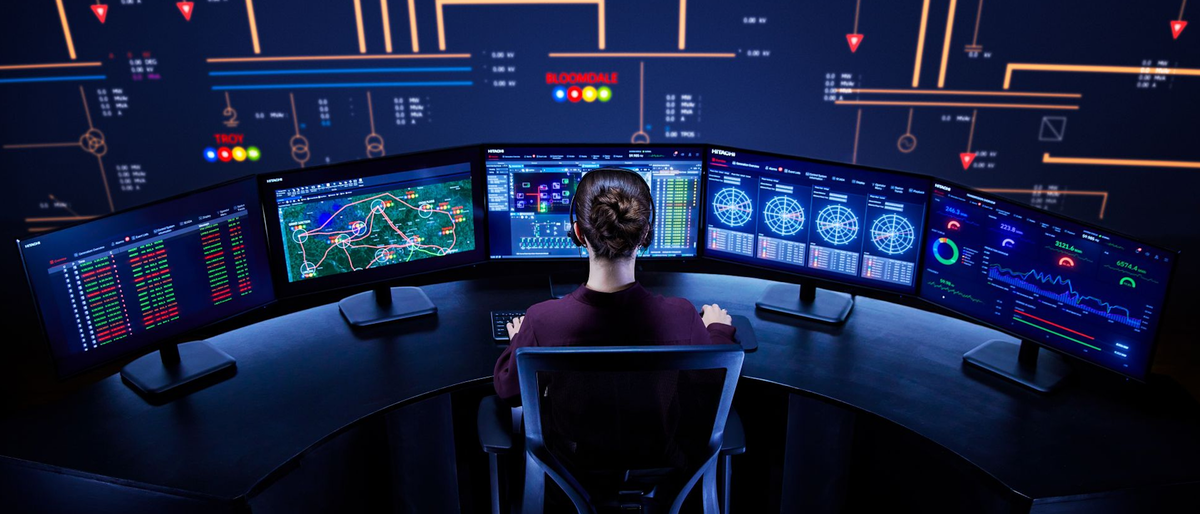
ADMS expertise built for a more complex grid
An advanced distribution management system (ADMS) helps utilities monitor and manage the distribution electricity networks that deliver power to homes and businesses. It brings network data and operational tools together so that control room operators can identify emerging problems, evaluate responses, and restore service safely during outages.
That visibility and control are increasingly important as rooftop solar, batteries, and electric vehicles reshape networks originally designed for one-way power flows. Rising demand, aging infrastructure, and extreme weather add to the challenge, making it essential for operators to understand changing conditions and act quickly.
Hitachi Energy’s Network Manager ADMS gives operators a shared, up-to-date view of the grid and tools to translate that information into action. It helps utilities:
- Strengthen grid reliability and resilience
- Reduce outage duration and accelerate restoration
- Enable greater DER and renewable integration
- Improve operational efficiency through automation
- Support regulatory compliance and protect the license to operate
These capabilities build on more than 130 years of Hitachi Energy’s utility-sector heritage and decades of grid operations software development worldwide.
The IDC MarketScape states: “Hitachi Energy draws on a deep bench of grid-automation and control-system engineering talent concentrated in Europe, a legacy of the ABB Power Grids organization that developed Network Manager over more than three decades. That continuity shows in the solution itself: the platform’s SCADA foundation is shared across transmission and distribution, its distribution state estimation handles high-DER conditions without requiring telemetry from every resource, and some operators highlight the vendors’ willingness to engineer capabilities for grid-specific conditions that fall outside standard product scope.”
The report advises: “Consider Hitachi Energy when seeking a deeply integrated SCADA, DMS, OMS, switching, and DER-aware operational platform, particularly for large or complex utilities that value a common real-time network model, strong outage and restoration capabilities, advanced network analysis, and the ability to coordinate distribution operations with adjacent transmission-control environments.”