
MGB Railway Modernization in the Swiss Alps
Customer Story | 4 min read
Customer Story | 4 min read
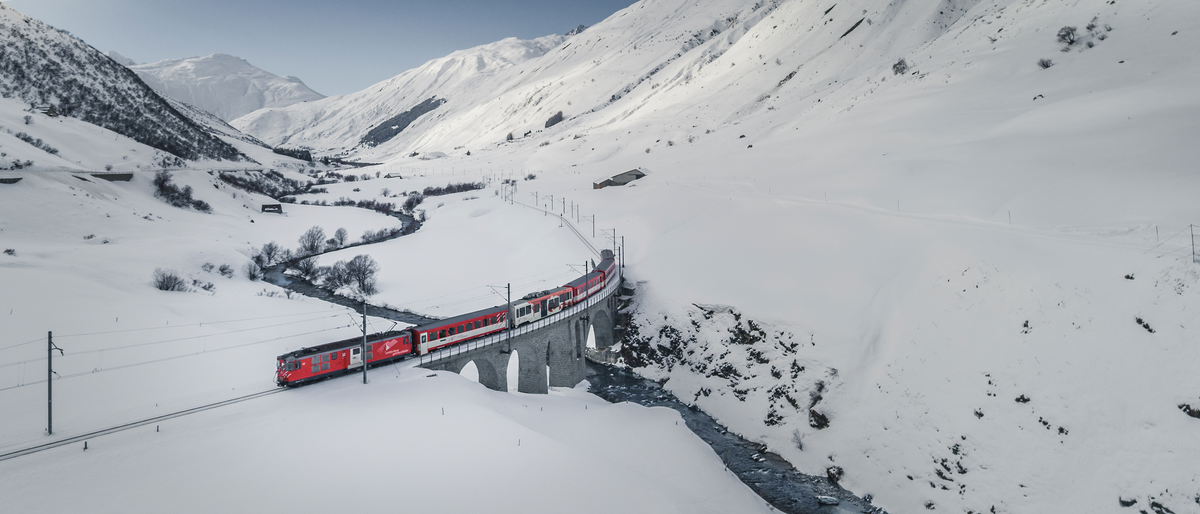
Across the high mountain passes of southern Switzerland, the Matterhorn Gotthard Bahn (MGB) railway has been connecting communities, supporting tourism, and navigating some of Europe’s most dramatic terrain for more than a century. Its network stretches 144 kilometers, crossing 170 bridges and 80 tunnels, reaching altitudes of up to 3,300 meters as it carries over 8.6 million passengers each year. Reliability is not optional here—it is the foundation that keeps people, goods, and tourism moving in one of the most demanding railway environments in the world.
Today, MGB is on a journey to modernize its operations, making its railway more digital, more resilient, and better prepared for the next generation of rail services. At the center of that transformation is a new mission-critical communication backbone built with Hitachi Energy’s MPLS-TP packet transport technology.
Running a railway through the Alps is both beautiful and complex. Weather conditions shift rapidly, temperatures drop dramatically, and long tunnels and steep valleys limit traditional communication options. MGB’s legacy TDM-based telecom network had served the railway for years, but it was not built for the demands of modern digital operations—nor for the increasing volume of data required by emerging applications such as real-time monitoring, modern signaling systems, and predictive maintenance.
To support its long-term vision, MGB recognized that it needed a communications upgrade: a secure, scalable, high-availability backbone that could deliver deterministic performance for mission‑critical railway services, even in extreme alpine conditions.
MGB partnered with Hitachi Energy to deploy a modern MPLS-TP network—one of the first railway implementations of its kind in Switzerland. The project included the extension of the existing XMC25 nodes across key locations such as Andermatt, Disentis, Oberwald, and Oberalppass, creating a transport layer capable of supporting both current and future digital applications.
This wasn’t simply a technology upgrade. It was a close collaboration built on technical workshops, operational alignment, and meticulous planning to ensure uninterrupted railway service during migration.
From the professional advice to the technical support, the solutions delivered were well thought-out and customer-focused. We highly recommend the Hitachi Energy technical team behind this project.
With the new MPLS-TP network, MGB benefits from:
Railway digitalization depends on secure, always on communication. With its new MPLS-TP backbone, MGB now operates with improved availability, higher bandwidth, and greater flexibility to introduce new services without compromising reliability.
This upgrade also plays a pivotal role in the replacement of the Andermatt signaling interlocking, one of the most important safety-critical systems on the route. The new telecom infrastructure ensures the speed, synchronization, and deterministic traffic behavior required for modern signaling and control systems, supporting MGB’s broader operational modernization.
Additionally, the system’s future‑proof design supports:
The result is not just a more modern network—but a more intelligent, safer, and adaptable railway.
Following the successful deployment in the Disentis–Andermatt region, MGB chose Hitachi Energy to expand the MPLS-TP architecture to additional valleys and routes, including the Goms and Matter valleys. These extensions will unify the communication network across the entire line, enabling consistent, high-performance connectivity from end to end.
MGB’s transformation is an example of how railways worldwide can embrace the shift toward digital operations—carefully, strategically, and with the right technology partners. By investing in a mission-critical telecom backbone built for extreme environments, the railway is strengthening safety, improving operational resilience, and enabling smarter mobility for generations to come.
In the heart of the Swiss Alps, a digital-ready railway is taking shape—and its journey forward is just beginning.

