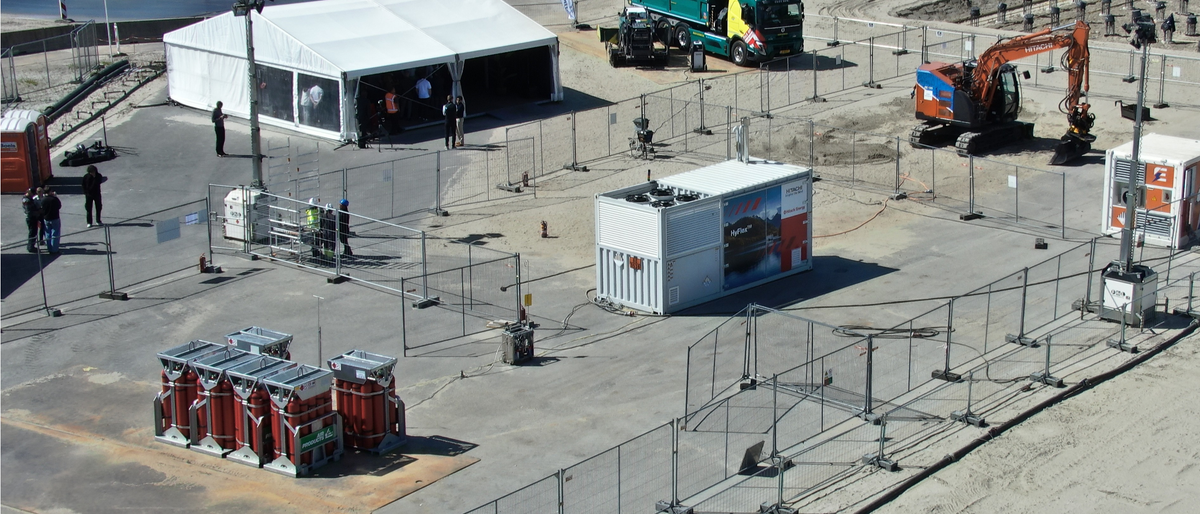
In a live event in Rotterdam, Hitachi Energy successfully introduced HyFlex™, its hydrogen-powered generator based on zero-emission fuel cell technology, marking its debut in the Netherlands. The event represents a significant step toward cleaner construction practices, underscoring the strength of cross-industry collaboration in advancing decarbonization. Working in synergy with Air Products, the world’s largest hydrogen supplier; Hitachi Construction Machinery, a provider of ZE135, a battery-type electric excavator; and Dura Vermeer, a leader in sustainable and innovative construction solutions, Hitachi Energy brought together key players in the clean energy ecosystem to make the demonstration possible.
Green hydrogen is becoming increasingly central to the energy transition. It offers strong potential to drive industrial decarbonization due to its versatility as a clean energy carrier and its ability to indirectly electrify hard-to-abate sectors. The construction sector alone accounts for over a third of global energy-related CO2 emissions1, yet the footprint of building operations continues to rise.
Policy momentum is also playing a key role, with forward-looking regulations and incentives—such as the EU’s revised Energy Performance of Buildings Directive2, Oslo’s climate and environmental requirements for construction sites3, and the Netherlands’ roadmap for zero-emission construction equipment4— highlighting both need and demand to accelerate the adoption of cleaner alternatives to conventional fossil fuel generators.
Hitachi Energy’s hydrogen-to-power solution produces electricity, usable heat, and water without combustion, thus emitting no harmful pollutants and operating nearly noise-free. Compared to conventional diesel power generators, a 500 kilovolt-amperes (kVA) HyFlex can reduce diesel fuel consumption by up to 800 tons per year, saving 2,900 tons of CO2 emissions. To generate one megawatt-hour (MWh) of electrical energy, it consumes approximately 70 kilograms of green hydrogen.