Hitachi Energy enables the kick-off of heavy-duty fleet electrification at Södra Cell
Features | 10.02.2026 | 3 min read
Features | 10.02.2026 | 3 min read
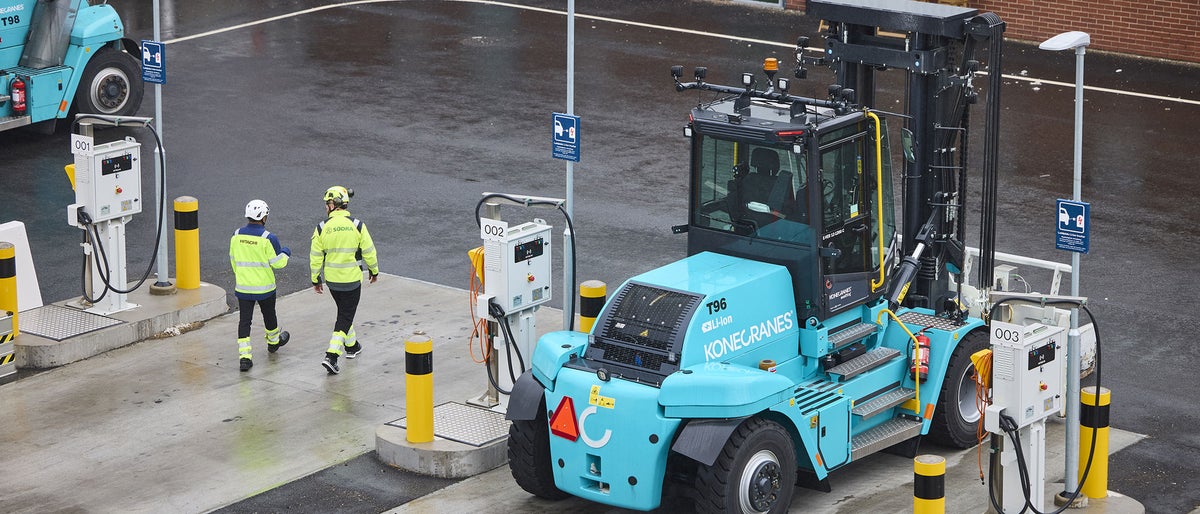
When two sustainability-driven companies join forces, the result is a powerful collaboration with a lasting impact. That’s the case at Södra Cell’s Värö facility, one of the world’s most advanced softwood kraft pulp mills, where Hitachi Energy’s Grid-eMotion® Fleet charging system is powering the electrification of heavy-duty forklifts. This deployment marks a global first for this solution in industrial fleet electrification, setting new standards for the sector and supporting Södra’s climate roadmap1, with the electrification of operational machinery and trucks representing a key step toward halving emissions by 2030.
Södra Cell’s facilities collectively produce 1.9 million tons of sustainable, renewable, and recyclable paper pulp - annually, with 40 percent of that output originating from the Värö site. For the group, electrification is part of Södra´s sustainability strategy. Byproducts such as bark are used for bioenergy, steam generates electricity, and surplus heat supports district heating, creating a closed-loop model that maximizes efficiency and minimizes waste.

Hitachi Energy’s Grid-eMotion Fleet modular charging system enables the expansion of electrification with minimal impact on infrastructure, transforming a single installation into a platform for long-term, cost-effective growth. The solution also offers lower costs, faster commissioning, and simplified interfaces compared to conventional systems, potentially saving up to 60 percent in space and 40 percent in cabling.
“At Södra we make the most of the whole tree, and we do the same with our energy. Electrifying internal transport has been a natural choice for us,” says Daniel Isaksson, Electrification Specialist at Södra Innovation & Strategy.
Through Hitachi Energy's charging solution and associated training, the facility has created the conditions to reduce service costs by 25 percent. Electrification has also improved indoor air quality, which is crucial considering that half of the unloading takes place indoors, by significantly reducing exhaust emissions. For each electric heavy-duty pallet truck, Södra reduces carbon dioxide emissions by 8,000 kg/year compared to HVO, the fuel currently used in the internal vehicles.
"It is refreshing to collaborate closely with such a forward-leaning company within the pulp & paper and forest industry that fully embraces new technology to develop its business within sustainable standards," says Marco Berardi, Head of Grid & Power Quality Solutions and Service at Hitachi Energy. "Our charging solution Grid-eMotion Fleet is highly scalable, allowing Södra to increase capacity as needed to advance further their goal of becoming fully decarbonized."
Beyond emissions, the shift to electric heavy-duty pallet truck has also improved working conditions. Drivers now operate in quieter cabins, free from fumes and harsh vibrations, creating a healthier and more comfortable environment. Electric vehicles have quickly gained favor among operators, who cite cleaner air, reduced fatigue, and a smoother ride as standout benefits.
The push for electrification in the trucking segment is gaining momentum, driven by its social and environmental benefits, most notably reductions in greenhouse gas emissions, lower noise pollution, and improved public health. In Europe, heavy-duty vehicles account for approximately 25 percent of CO₂ emissions from road transport2, while one in five people is exposed to harmful traffic noise, according to the World Health Organization3.
Hitachi Energy is undertaking major expansions in Sweden to strengthen local manufacturing capacity and secure recruitment in the country. These initiatives are part of a global investment program of more than USD 9 billion, the largest in the industry, in which Hitachi Energy is expanding its manufacturing capacity, R&D, technology and partnerships to make the world's energy system more reliable, secure and resilient.