地域と言語を選択してください

メニュー

From Europe’s factories to the world’s digital backbone: European-made transformers power critical AI infrastructure

Features | Europe | 08.06.2026 | 3 min read

Mission-critical transformers delivered from Europe to the United States in record time, supporting the next generation of AI and cloud computing.

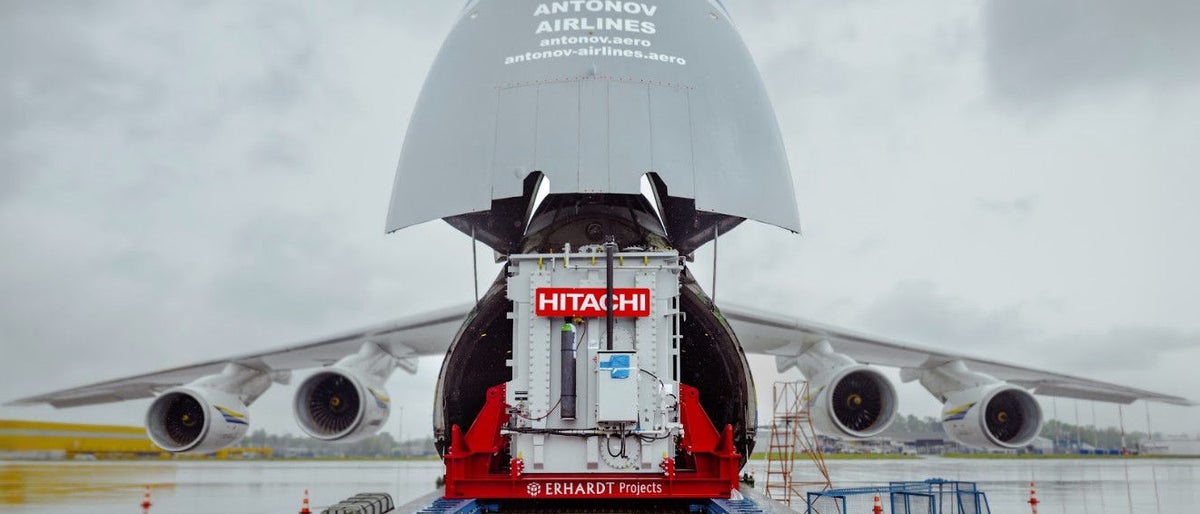
Hitachi Energy recently completed a time-critical project that demonstrates the strategic importance of Europe’s transformer manufacturing base. Two large power transformers, designed and manufactured in Europe, were delivered within a highly compressed timeframe to support a hyperscale data center project in the United States.

Each transformer delivered to the US weighed over 80 tonnes and required one of the world’s largest cargo aircraft, the Antonov An‑124, to be transported safely across the Atlantic. The operation involved a tightly coordinated journey from Lodz, Hitachi Energy’s largest transformer manufacturing Campus in Europe, to Warsaw by land and onward to Chicago. 

Transporting transformers of this size by air is exceptionally rare, highlighting both the urgency of the project and Europe’s ability to deliver critical grid infrastructure at speed and scale.

As global electricity demand rises, also driven by data centers, power systems must scale faster and more reliably. At the center of this challenge are transformers, and the industrial capacity to deliver them when delays are not an option.

Europe’s grid-technology base provides a strong foundation to respond. More than 600 companies, 450 factories and over 175,000 employees form a highly specialized industrial ecosystem across transmission and distribution technologies, including transformers: underpinning Europe’s ability to deliver complex grid equipment at speed and scale.

Beyond the logistics, the project highlights a broader system reality. The world’s electricity challenge is no longer primarily about generating power, but about whether the grid can scale fast enough to meet rising demand from electrification, data centers, and AI, while maintaining security, affordability, and resilience.

Bruno Melles
CEO Transformers Business Unit
Hitachi Energy

Transformers are increasingly recognized as strategic infrastructure, essential for grid expansion, industrial electrification, renewable energy integration, and AI-enabled digital infrastructure. They are also highly material-intensive assets, relying on specialized steel, copper, and aluminum, as well as sophisticated supply chains and advanced manufacturing capabilities.

Europe is today a global leader in transformer technology with a significant manufacturing footprint and a strong export position. In 2025, EU exports across key transformer categories reached approximately $4.2 billion USD according to Eurostat, with large power transformers accounting for nearly half of that total, making Europe one of the world’s leading exporters in this segment.

At the same time, global competition is intensifying. China has become the largest transformer manufacturing base globally, supported by scale, domestic demand and vertically integrated supply chains. Europe occupies a different position in the value chain, leading in high-voltage, HVDC, offshore and high-efficiency transformer technologies, underpinned by advanced engineering standards, strong innovation capabilities and a highly skilled workforce.

Maintaining this talent base is not only an employment concern – it is a delivery constraint for Europe’s grid buildout and industrial resilience. The ability to design, manufacture, and mobilize large transformers at short notice is a direct outcome of sustained industrial capability and coordinated ecosystems – and that capability needs to be preserved and further developed. Amid ongoing discussions about industrial safeguards and supply chain security, this project offers a tangible example of why transformer manufacturing and its upstream inputs should be treated as strategic infrastructure instead of a standard industrial category. Policy choices that constrain availability of critical inputs risk slowing grid expansion precisely when Europe aims to accelerate electrification and competitiveness. 

Decisions taken in the coming years will shape the electricity systems that power the next 25 years. As European policymakers consider regulatory frameworks, safeguard measures, and industrial policy choices, this project offers a clear illustration of what is at stake.


Transformer manufacturing is not simply another industrial activity; it is strategic infrastructure. Recognizing, supporting, and securing this industrial base is essential to delivering Europe’s electrification ambitions, maintaining competitiveness, and strengthening long‑term energy resilience and sovereignty.

Maxine Ghavi
Region Head Europe
Hitachi Energy

While this project supported critical infrastructure outside Europe, it was enabled by European manufacturing strength and technology heritage. This transatlantic journey underscores a broader reality: European engineering, and industrial capacity connect to global energy and digital systems. Just recently, Hitachi Energy announced the transportation of its largest ever built HVDC VSC transformer from Sweden to China. Both projects demonstrate how Europe’s transformer industry underpins not only regional electrification, but also the global digital economy – reinforcing the case for treating this sector as a cornerstone of Europe’s energy and industrial strategy.