
Advanced Line Protection: The Grid’s Smart Control Tower
Blog Post | 04.08.2026 | 6 min read
Blog Post | 04.08.2026 | 6 min read
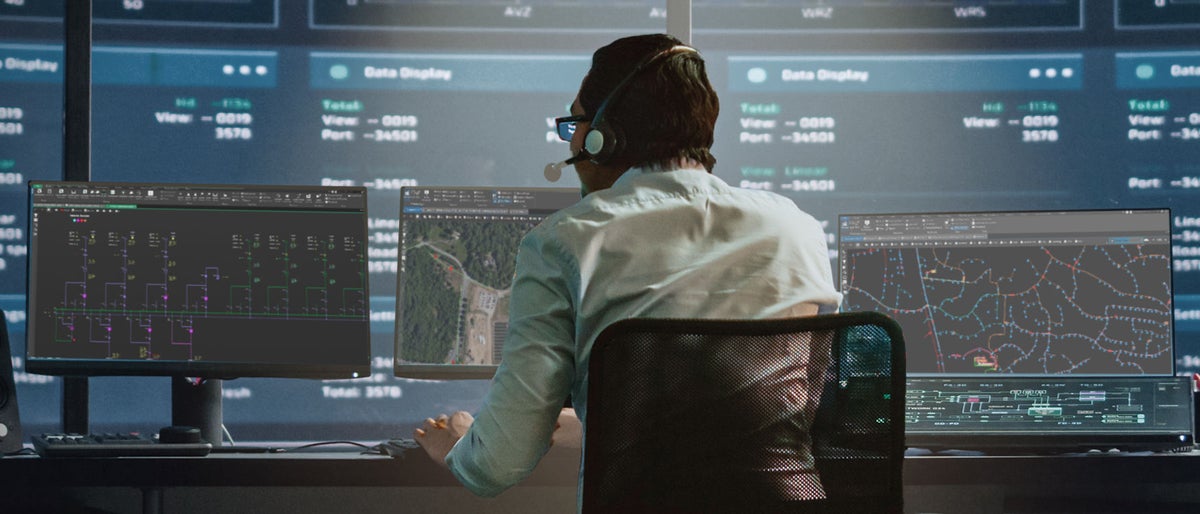
The modern grid is beginning to resemble a major airport in bad weather: crowded, complex, and constantly changing. Safety does not depend only on adding more runways. It depends on a control tower that can read every signal with precision.
As electricity demand rises and power flows become more dynamic, advanced line protection is becoming central to energy security. The energy transition is often framed as a race to build more renewables, storage, transmission, and distribution capacity. But scale alone will not make the grid more secure or resilient. The grid must also understand, monitor, analyze, and act fast enough when conditions change.
The next energy security challenge is sharper and more urgent: can the grid make the right decision when conditions change in milliseconds?
In 2026, the International Energy Agency forecasted global electricity demand to grow by an average of 3.6% per year between 2026 and 2030, at least 2.5 times faster than overall energy demand. That is not only a demand story. It is a protection story, because busier grids make faults harder to read.
Protection has always had one mission: detect faults, isolate them quickly, and protect the rest of the system. Protection and control IEDs help clear potentially hazardous faults, protecting equipment, operations, and people. But speed alone is no longer enough. In a more dynamic grid, protection must also judge whether an electrical disturbance is a real fault or a complex but healthy operating condition.
Next-generation protection is not about tripping faster at any cost. It is about understanding the grid better, so protection can remain sensitive enough to detect difficult faults, secure enough to avoid unnecessary trips, and selective enough to isolate only the faulty part of the system while the rest keeps running.
In a world where electricity underpins industry, transport, healthcare, data, and daily life, milliseconds have strategic value.
Distribution networks are becoming the front line of electrification. They are where electric vehicles connect, distributed renewables feed power back into the system, data centers and industrial loads intensify demand, and customers feel reliability most directly.
As these networks take on more active resources, their operating behavior is changing. Once relatively quiet regional terminals, distribution grids are becoming busy hubs with more connections, bidirectional power flows, and less predictable conditions.
This makes medium-voltage protection more complex and more critical. Traditional approaches were designed for strong, predictable fault currents. But inverter-based resources such as solar, wind, and power-electronics-based loads can behave differently during faults. Fault currents may be lower, shaped differently, or harder to classify. Modern earthing methods can also make some faults harder to detect. In these conditions, protection cannot rely on old signals. It must interpret new ones.
That is why next-generation distance protection and line differential protection in the Relion REF650 medium-voltage protection and control relay are relevant. Distance protection uses voltage and current measurements to assess the electrical distance to a fault. Line differential protection compares currents at different ends of a protected line to identify internal faults with high selectivity. In modern distribution systems, the challenge is to identify what changed, where it happened, which phases are involved, and which part of the grid should be isolated.
REF650 brings this intelligence into medium-voltage protection. It supports a more adaptive approach to networks that are becoming more active, more distributed, and more essential to the energy transition. The value is confidence: protecting critical distribution assets without adding unnecessary complexity.
At the transmission level, the challenge is different but equally important. Long lines, offshore export cables, shunt reactors, high capacitance, transient behavior, complex grid configurations, and varied earthing methods can make differential protection harder. Conventional differential protection compares current entering and leaving a protected zone. In complex systems, that simple principle can become difficult to apply.
Healthy operating conditions can look unusual. A genuine fault may appear minor at first. Charging currents, transients, and settings tradeoffs can complicate the signal. Protection must distinguish a real fault from normal system behavior without becoming either too sensitive or too conservative.
This is why the newly developed adaptive model-based line differential protection method in Relion RED670 matters. Instead of relying only on fixed assumptions, model-based protection uses a deeper representation of the protected system to help distinguish healthy behavior from real faults. It reduces ambiguity and helps protection remain both sensitive and secure where conventional approaches can face limits.
For offshore wind and cable-heavy applications, this matters. These are high-value assets in demanding conditions, where downtime, maloperation, and slow restoration all carry cost. The grid needs protection that can isolate precisely, support faster recovery, and give operators confidence when the system is difficult to interpret.
Put simply, the RED670 IED shows how differential protection is evolving from comparison to comprehension.
Demand growth and system complexity are rising together. In 2026, the IEA said power systems would need greater flexibility to integrate a more diverse mix of generation sources while adapting to changing demand patterns and technologies.
That need is being driven by converter-based solar PV and wind, battery storage, electric vehicles, heat pumps, data centers, and other large loads that are reshaping how power systems operate.
The World Economic Forum has made the energy security point directly: infrastructure designed for a different era is struggling to keep pace with demand, while grid bottlenecks and aging assets are restricting further renewable growth.
The bottleneck is not only capacity. It is also control. As grids become more flexible, digital, and renewable-rich, protection must interpret less predictable fault behavior and act precisely under pressure.
The energy transition is also a trust transition. Societies will electrify faster only if electricity remains reliable. Industries will decarbonize at scale only if power quality and continuity are dependable. Digital economies will grow only if the grid can support them securely. That trust depends on how well the grid responds when something goes wrong.
The REF650 and RED670 IEDs represent two sides of the same shift. REF650 brings line differential protection and next-generation distance protection into medium-voltage networks that are becoming more active and more critical to electrification. RED670 brings adaptive model-based line differential protection into complex transmission and offshore environments where grid behavior is harder to read and protect.
Together, they point to the next chapter of protection: from devices that react to systems that understand.
This is one of the defining engineering challenges of the electricity era. We need to build a bigger and cleaner grid. Above all, we need a grid that can interpret complexity, act with precision, and recover with confidence.
In a storm, the safest airport is not the one with the most runways. It is the one with the clearest control tower. The grid is reaching that same moment. Energy security will depend on whether it can read the signals, separate real danger from normal turbulence, and act with precision.
Next-generation protection helps give the grid that intelligence, keeping power secure, reliable, and flowing as conditions change.
Learn more about Hitachi Energy’s advanced protection and control solutions for modern power systems.
