
AusNet connects Mortlake BESS to Australia’s power grid with Hitachi Energy’s advanced transformers technology
Customer Story | 4 min read

Customer Story | 4 min read
Australia’s renewable energy transition is rapidly advancing, with wind and solar projects now delivering a growing share of electricity. To ensure this clean energy reaches consumers reliably, it must be integrated seamlessly into the transmission grid. Given the variability of these sources, large-scale Battery Energy Storage Systems (BESS) have become critical. They store surplus energy during peak generation and release it when demand rises, helping stabilize the grid and improve supply resilience.
Even the smartest batteries need a boost — power transformers are the key to unlocking their full potential, ensuring stored renewable energy reaches the grid safely and efficiently.
Challenges
The Mortlake Power Station is Victoria’s largest gas-fired generator, with a generation capacity of 566 megawatts. The Mortlake BESS project adds 300 MW / 650 MWh of storage capacity, with the ability to dispatch energy over variable durations as needed. AusNet, as the transmission network operator, must connect the project to the 500 kV grid, enabling stored renewable power to flow to homes, businesses, and industries across Victoria.
Unlike conventional power plants, BESS sites are compact, with hundreds of battery containers and inverters installed side by side. This makes safety and reliability a top priority because every piece of equipment must perform consistently under high electrical stress. This is especially true for transformers, which are critical to allowing energy to flow into the transmission system.
What makes a BESS unique is its flexibility. This system will be able to deliver quick bursts of energy to help stabilize the grid in moments of disturbance or provide sustained output over several hours to meet demand during peak periods.
Solution
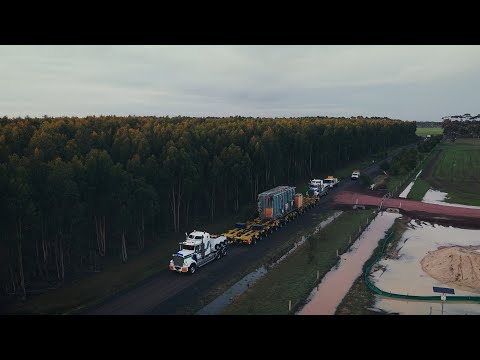
Hitachi Energy delivered two 500 kV, 180 MVA power transformers purpose-built for this BESS integration. These units form the vital link between the Mortlake BESS and Victoria’s transmission grid, stepping up the battery system’s output voltage to 500 kV for efficient long-distance transfer.
Built for durability, the transformers are designed to deliver long-term performance over decades of operation, even under the unusual and demanding load patterns of BESS.
The transformers were engineered with a suite of safety and resilience features. Their advanced cooling systems maintain stable operating conditions under Australia’s high temperatures and during rapid, dynamic load cycles, reducing thermal stress and improving reliability.

Configured in a parallel arrangement, the two 180 MVA units share the load under normal operation, while each transformer is capable of supporting the full BESS output independently in case of emergency. This redundancy, combined with high-efficiency cooling, ensures continuous operation and grid stability even under fault or maintenance conditions.
Both units are also equipped with TXpert™ digital monitoring technology, which provides continuous real-time tracking of performance data. This enables operators to detect anomalies early, apply preventive maintenance, and safeguard these critical grid assets throughout their life cycle.
This combination of global reach and engineering excellence gives customers like AusNet the confidence that critical assets like power transformers will perform safely and reliably for decades.
Benefits
The connection of the Mortlake BESS to the grid demonstrates AusNet’s ability to integrate large-scale renewable storage into one of the highest-voltage networks in the country with confidence in long-term safety and reliability. For Victoria, it delivers new flexibility in balancing renewable generation with consumer demand, reducing pressure on the grid and supporting the stability of supply even as fossil fuel generation declines.
At a national level, Mortlake sets a precedent for how Australia can accelerate its clean energy transition: by combining advanced storage with grid infrastructure designed for resilience. Hitachi Energy’s transformers make this possible by ensuring that the energy stored in the BESS can flow securely into the grid, creating tangible value for local communities and industries.
For AusNet, the benefit is twofold: the assurance of operating a critical asset safely in a demanding environment, and the confidence of relying on equipment designed for long life cycle performance. This enables AusNet to provide its customers and stakeholders with infrastructure that is not only resilient today but future-ready for decades to come.
By enabling this milestone project, Hitachi Energy supports AusNet in its role as a trusted grid operator at the center of Australia’s renewable transformation.

We’re proud to deliver the transmission infrastructure for the Mortlake BESS project: an initiative that strengthens Victoria’s energy resilience and supports Australia’s clean energy future. To realize this vision, we’ve partnered with Hitachi Energy, an industry leader with global expertise and local support. Their advanced transformer technology is essential to the success of this project, helping us deliver high-performance, future-ready infrastructure.
