Välj din region och ditt språk

OK

Meny

Powering Switzerland's Rail Network for More Than a Century

Customer Story | 3 min read

From early electrification to modern energy-efficient traction systems, Hitachi Energy Semiconductors has played a decisive role in shaping Switzerland’s railway network. For more than 100 years, our power semiconductor technologies have been at the heart of reliable, efficient and sustainable rail transport – in Switzerland and far beyond.

A legacy rooted in Swiss rail electrification
Switzerland is a global pioneer of railway electrification, driven by early industrial innovation and abundant hydropower. As early as 1913, the technological roots of today’s Hitachi Energy were involved in developing and manufacturing rectifier technologies for rail applications. These solutions were soon deployed on Swiss tram and railway systems, supporting the transition from steam and mechanical drives to electric traction.
Over the following decades, continuous innovation in power electronics accompanied the evolution of Swiss rail transport. Successive generations of power semiconductors – from diodes and thyristors to GTOs and later IGBTs – enabled trains to become more powerful, more reliable and easier to control. Many generations of mainline, regional and mountain rail vehicles developed in and for Switzerland relied on traction concepts made possible by these technologies, forming a strong and enduring link between Swiss railways and semiconductor innovation.

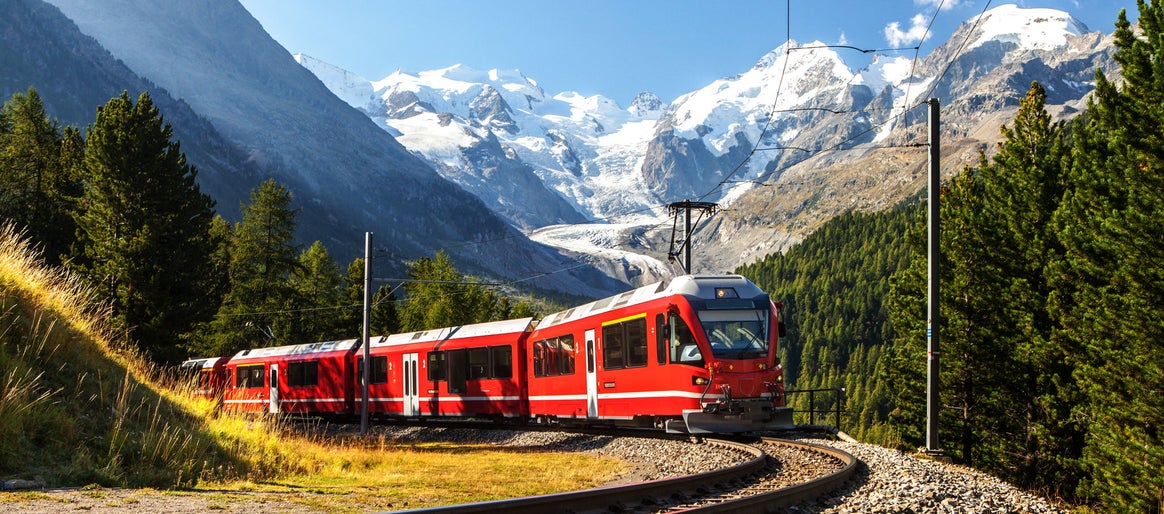
Swiss train in a field of flowers

Challenge: doing more with less energy
Railway systems operate under demanding conditions. Limited installation space, long vehicle lifecycles and harsh environmental exposure require components with exceptional reliability. At the same time, railway operators face increasing pressure to improve energy efficiency, reduce losses and meet ambitious sustainability targets.
Earlier traction systems allowed only unidirectional power flow: energy was consumed during operation, but braking energy could not be recovered. As energy costs rose and decarbonisation became a strategic priority, rail transport required technologies that could actively feed energy back into the grid while maintaining maximum availability and operational safety.

Our solution: advanced power semiconductor technology
Hitachi Energy Semiconductors addresses these challenges through continuous innovation in power semiconductor technology for railway traction systems. Our HiPak and LinPak modules are key components in traction converters, where they switch and control electrical power to convert the supply from the overhead line into the voltage and frequency required by the traction motors. This enables efficient, reliable motor control across a wide range of operating conditions.
Each new technology generation increases power density while reducing electrical losses, helping traction converters become more compact, efficient and thermally optimized. Modern semiconductor solutions also enable bidirectional power conversion, making regenerative braking possible. This allows braking energy to be fed back into the railway power network where infrastructure conditions allow, or otherwise used more effectively within the system. The result is lower overall energy consumption and more sustainable rail operation.
While the core function remains the same — efficiently controlling and transferring energy from the power supply to the motor — today’s solutions achieve this with far greater precision, compactness and reliability than earlier generations.

Today, Hitachi Energy Semiconductors continues to play a central role in the European rail ecosystem. Our technologies are embedded in traction systems that operate daily across Switzerland, supporting high availability, long asset lifetimes and reduced environmental impact.        By combining more than a century of engineering expertise with continuous innovation in silicon and silicon‑carbide technologies, we help shape the future of electric rail transport. Our power semiconductors enable trains to run cleaner, more efficiently and more reliably – contributing to a railway system that remains a benchmark for sustainable mobility, today and for generations to come.