Välj din region och ditt språk

OK

Meny

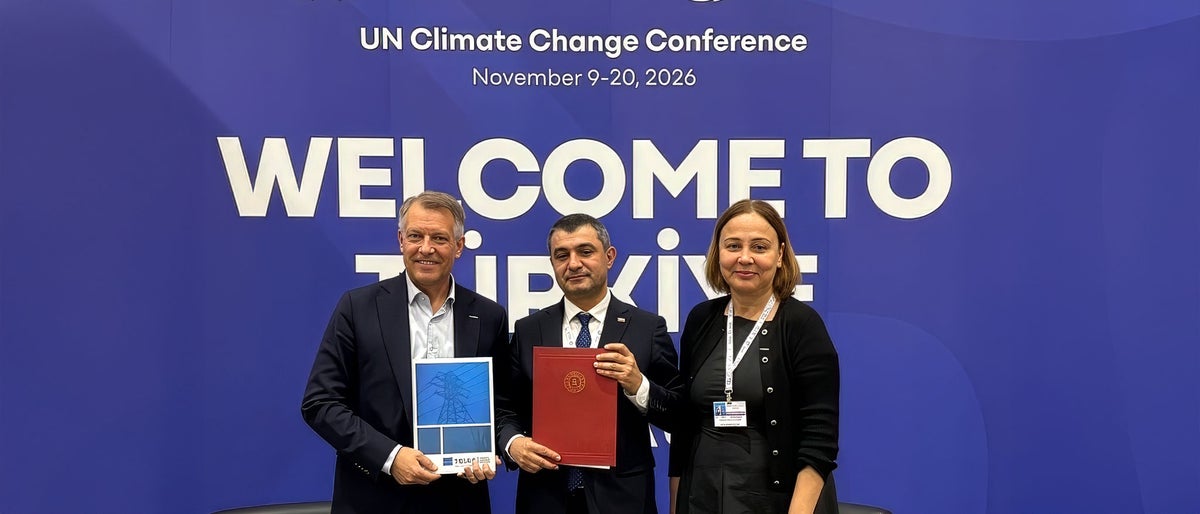
From the left: Niklas Persson, CEO of the Grid Integration business at Hitachi Energy, Mustafa PUSTU, General Manager of TEİAŞ and Yasemin Oztekin, Country Managing Director Hitachi Energy in Türkiye

TEİAŞ looks to Hitachi Energy’s HVDC as Türkiye embraces the age of electricity

Press Release | Türkiye | 12.11.2026 | 3 min read

As Türkiye accelerates electrification and renewable energy, stronger grids and greater regional interconnection are becoming critical to its energy future.

“The future belongs to the age of electricity.”

That was the message from Türkiye’s Energy Minister Alparslan Bayraktar as the country set out an ambitious new direction for its energy system around COP31. The government has placed electrification at the center of its energy strategy.

Türkiye’s National Energy 2040 vision targets 281 gigawatts (GW) of installed capacity, up from approximately 128 GW today, including 175 GW of solar and wind, growing renewables’ share from around 63 to 77 percent.1

Türkiye also needs transmission infrastructure to move growing electricity volumes efficiently and reliably nationwide and beyond its borders.

Putting HVDC at the heart of the conversation

Hitachi Energy and Türkiye Elektrik İletim Anonim Şirketi (TEİAŞ), Türkiye’s national transmission system owner and operator, are collaborating on high-voltage direct current (HVDC) transmission.

They will establish a framework for technical cooperation, joint studies and knowledge sharing on Türkiye’s current and future HVDC needs, exploring the integration of renewables, power-system connections, grid flexibility and resilience.

HVDC efficiently transmits large electricity volumes over long distances and connects power systems, vital as renewables and cross-border clean-electricity trade grow.

Türkiye is increasingly looking beyond its national grid.


Connecting Türkiye to a wider electricity system

At COP31, Türkiye, Azerbaijan, Bulgaria and Georgia signed a clean-energy partnership to advance cross-border electricity transmission, distribution and trade, integrating their grids to strengthen regional energy security.

A proposed clean-energy corridor would connect these countries to European markets, highlighting the growing role of interconnectors in moving clean electricity across borders and regions.

The global challenge is clear: can grids and interconnections keep pace with electrification and renewable growth?


The grid must keep pace

The electricity era will only move as fast as the grids that enable it. Strengthening transmission infrastructure and building more interconnections between power systems are critical to moving clean electricity at scale. Through our collaboration with TEİAŞ, we can bring our global HVDC experience together with their deep knowledge of Türkiye’s power system to support a stronger, more connected and resilient grid.

Niklas Persson, CEO of the Grid Integration business at Hitachi Energy

It is a message Persson is also taking to COP31: generating more clean electricity is only part of the equation. The ability to move electricity efficiently across regions and, increasingly, across borders is becoming equally important.

As wind and solar grow, stronger transmission and interconnection can link renewable-rich areas with demand centers and enable flows between power systems.


Looking beyond today’s grid

The collaboration looks beyond individual developments to HVDC’s longer-term role in Türkiye’s electricity system.

They plan to explore renewable energy corridors, cross-border interconnections, back-to-back converter stations, multi-terminal systems and future HVDC grid configurations, considering how international experience and reference projects could optimize and standardize Türkiye’s future HVDC developments.

Integrating Türkiye's rapidly growing renewable generation into the grid and carrying that energy reliably to where it is needed lies at the heart of our transmission planning.

HVDC technology will play a key role in this transformation, enabling us to transmit large volumes of clean electricity over long distances with low losses, while strengthening the stability and resilience of our power system. Through our cooperation with Hitachi Energy, we aim to draw on international experience and reference projects, carry out joint technical studies, benchmarking and detailed cost analyses, and further develop the know-how of our engineers. In this way, we will help ensure that Türkiye's future HVDC investments are planned and delivered in the most efficient and cost-effective manner, in support of our 2053 net zero target.

Mustafa PUSTU, General Manager of TEİAŞ

Türkiye’s direction is clear: greater electrification, substantially more renewables and stronger connections with neighboring power systems.

Delivering this requires both new generation and grids capable of moving clean electricity efficiently across regions, countries and markets.

In Türkiye’s age of electricity, connecting infrastructure will be as critical as the power itself.

About Hitachi Energy

Hitachi Energy is a global technology leader in electrification, powering a sustainable energy future with innovative power grid technologies with digital at the core. Over three billion people depend on our technologies to power their daily lives. With over a century in pioneering mission-critical technologies like high-voltage, transformers, automation, and power electronics, we are addressing the most urgent energy challenge of our time – balancing soaring electricity demand, while decarbonizing the power system. With an unparalleled installed base in over 140 countries, we co-create and build long-term partnerships across the utility, industry, transportation, data centers, and infrastructure sectors. Headquartered in Switzerland, we employ over 50,000 people in 60 countries and generate revenues of around $16 billion USD.

https://www.hitachienergy.com
https://www.linkedin.com/company/hitachienergy
https://x.com/HitachiEnergy

About Hitachi, Ltd.

Through its Social Innovation Business (SIB) that brings together IT, OT (Operational Technology) and products, Hitachi contributes to a harmonized society where the environment, wellbeing, and economic growth are in balance. Hitachi operates globally in four sectors – Digital Systems & Services, Energy, Mobility, and Connective Industries – and the Strategic SIB Business Unit for new growth businesses. With Lumada at its core, Hitachi generates value from integrating data, technology and domain knowledge to solve customer and social challenges. Revenues for FY2024 (ended March 31, 2025) totaled 9,783.3 billion yen, with 618 consolidated subsidiaries and approximately 280,000 employees worldwide. Visit us at https://www.hitachi.com.