
Expanding grid hosting capacity with C-LVR
Customer Story | 5 min read
Customer Story | 5 min read
The energy transition is reshaping distribution networks across Europe. As renewable generation continues to grow at an unprecedented pace, distribution system operators are under increasing pressure to connect new energy resources while maintaining grid stability and power quality. In many regions, the challenge is no longer generating renewable electricity but ensuring that existing networks can accommodate and deliver it efficiently.
To address this challenge, TEN Thüringer Energienetze Thuga Group and Hitachi Energy have partnered to explore innovative ways to increase grid hosting capacity and accelerate the integration of distributed energy resources without relying solely on costly and time-consuming grid expansion projects.
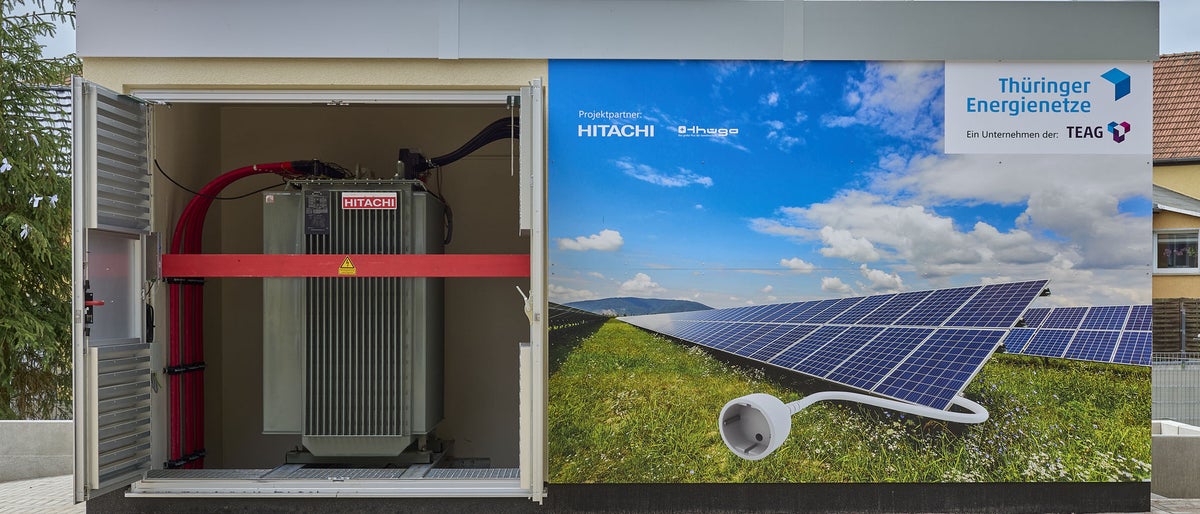
To support this next phase of power grid expansion, they deployed the first Compact Line Voltage Regulator (C-LVR), demonstrating how intelligent voltage regulation can unlock additional network capacity, increase renewable hosting capability, and enable a more efficient use of existing grid infrastructure.
Challenge
Across Europe, distribution grids are undergoing a profound transformation. The rapid growth of rooftop solar, battery storage systems, electric vehicle charging infrastructure, and other distributed energy resources is changing how electricity flows through the network. What were once predictable, one-directional power flows are increasingly being replaced by dynamic and bidirectional energy exchanges.
For distribution system operators, one of the most pressing consequences is voltage management. During periods of high renewable generation, voltage levels can rise beyond acceptable operating limits. As a result, networks that still have current-carrying capacity may nevertheless be unable to accommodate additional renewable energy connections.
In Germany, several distribution grid sections have already reached these operational limits, creating bottlenecks for further renewable integration. Traditional solutions often involve costly and time-consuming grid reinforcement projects. Utilities are therefore looking for smarter ways to increase hosting capacity and maximize the use of existing infrastructure while maintaining power quality and grid stability.
Hitachi Energy's Solution
To address this challenge, Hitachi Energy developed the Compact Line Voltage Regulator (C-LVR), an innovative solution that combines the functions of a line voltage regulator and a distribution transformer within a single compact, liquid-filled unit.
Building on Hitachi Energy’s existing Voltage Regulating portfolio of solutions, C-LVR extends proven voltage control capabilities into a compact, transformer-integrated design tailored for modern distribution networks.
Installed and operated like a conventional distribution transformer, C-LVR actively regulates voltage at the feeder level, automatically compensating for voltage fluctuations caused by renewable generation, electric vehicle charging, and changing load conditions. By integrating voltage regulation directly into the transformer footprint, it eliminates the need for separate voltage-regulation equipment, additional civil works, or extensive redesign of existing substations.

The solution is designed for seamless integration into standard compact secondary substations and can be deployed in both new installations and retrofit projects. Digital-ready and SCADA-compatible, C-LVR supports real-time monitoring and control while maintaining the simplicity, reliability, and familiarity utilities expect from conventional transformer technology.
The system installed for the Thüga Group was developed specifically to address medium-voltage feeder constraints and represents an important milestone in bringing this next-generation voltage regulation technology from concept to real-world deployment. The solution supplied combines 6 MVA feeder regulation capability with a 630 kVA distribution transformer function, delivering a highly efficient "2-in-1" approach.
Impact
The first C-LVR reference installation for the Thüga Group demonstrates how targeted voltage regulation can unlock significant additional grid capacity without the need for extensive network expansion.
The solution installed for TEN Thüringer Energienetze in Hopfgarten near Weimar (Germany) helps stabilize voltage on a constrained medium-voltage feeder, enabling substantially higher integration of distributed renewable generation.
Based on the forecasted calculations of this project scenario, the technology could allow the feeder to accommodate up to 260% more photovoltaic capacity while avoiding conventional reinforcement measures. In the pilot region alone, it could create sufficient capacity for thousands of additional small-scale solar installations.
For the grid operators within the Thüga Group, the benefits extend beyond increased renewable hosting capacity. The compact design minimizes installation effort and site modifications, while SCADA integration enables enhanced visibility and operational control. By leveraging existing grid infrastructure more effectively, utilities can accelerate renewable connections, improve voltage quality, reduce capital expenditure associated with grid expansion, and shorten project implementation timelines.
Most importantly, the project demonstrates a practical pathway for distribution system operators to transform voltage constraints into usable network capacity, supporting the energy transition with faster, more cost-effective, and scalable solutions. As the first reference deployment of the C-LVR concept, it also establishes a blueprint for future applications across Germany and Europe.
